



What to Do After a Truck Accident in Georgia

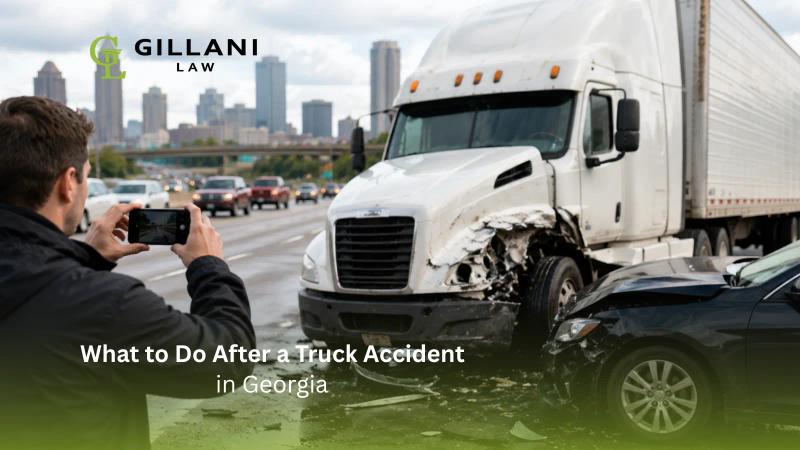
The first thing to do after a truck accident: get yourself and everyone with you out of traffic and call 911. What almost nobody tells you at the scene is that the next seventy-two hours decide whether truck accident cases in Georgia get won or lost, not the deadline two years down the road.
Large trucking companies have investigators on the road within hours of a crash. You will not have that head start unless you know what to look for right now.
What Are the Immediate Steps to Take After a Truck Accident?
- Move to safety if your vehicle is drivable, and turn on your hazard lights
- Call 911 and request police and medical response
- Get checked by a medical responder even if you feel uninjured
- Get the truck driver's name, employer, and insurance information
- Take photos of the vehicles, skid marks, road conditions, and any visible injuries
- Get contact details from anyone who saw the accident
- Avoid discussing fault with the truck driver or anyone else at the scene
Each of these protects something specific: your health, the official accident report, and the evidence that decides what your claim is worth. Here is why each one matters more than it looks.
Move to Safety and Call 911
Commercial trucks weigh up to twenty times more than a passenger car, so a second collision at the same site is often worse than the first. If you can move your vehicle without putting yourself at risk, do it, then make sure approaching traffic can see you.
Georgia law requires drivers to report an accident involving injury or significant property damage. Call 911 even if the damage looks minor. The responding officer will document the scene and prepare an official accident report, and that report becomes one of the first pieces of evidence any insurance company or attorney reviews.
Resist the urge to say anything that sounds like an apology or an admission. "I didn't see them" or "I'm sorry" feels like basic manners in the moment. Just instinct. It reads very differently later, when it gets used against you.
Get Medical Attention Even If You Feel Fine
Adrenaline is a good painkiller and a terrible diagnostic tool. Concussions, traumatic brain injuries, and spinal damage frequently show no symptoms for hours or days after a truck crash, because the forces involved are large enough to injure without immediately hurting.
Getting checked out at the scene, or at an emergency room the same day, does two things. It helps protect your health by catching injuries before they become harder to treat, and it creates a medical record that ties your injuries to the accident. Insurance adjusters look for gaps between the crash date and your first visit to a doctor. A three-day gap becomes their argument that something else caused your pain and suffering, not the truck accident.
Follow-up medical care matters just as much as that first visit. Skipped physical therapy appointments or gaps in treatment give an adjuster the same opening: an argument that your injuries were not serious enough to need ongoing attention, even when the truth is closer to the opposite.
Document the Accident Scene Before You Leave
If you are involved in a truck accident and are physically able, photograph everything: vehicle damage on all sides, spilled cargo, traffic signals, and your own visible injuries. Get the truck's license plate, DOT number, and company markings specifically. Trucking companies sometimes operate under a name that is different from the one on the truck's insurance policy, and that detail matters when you find out who the liable parties actually are.

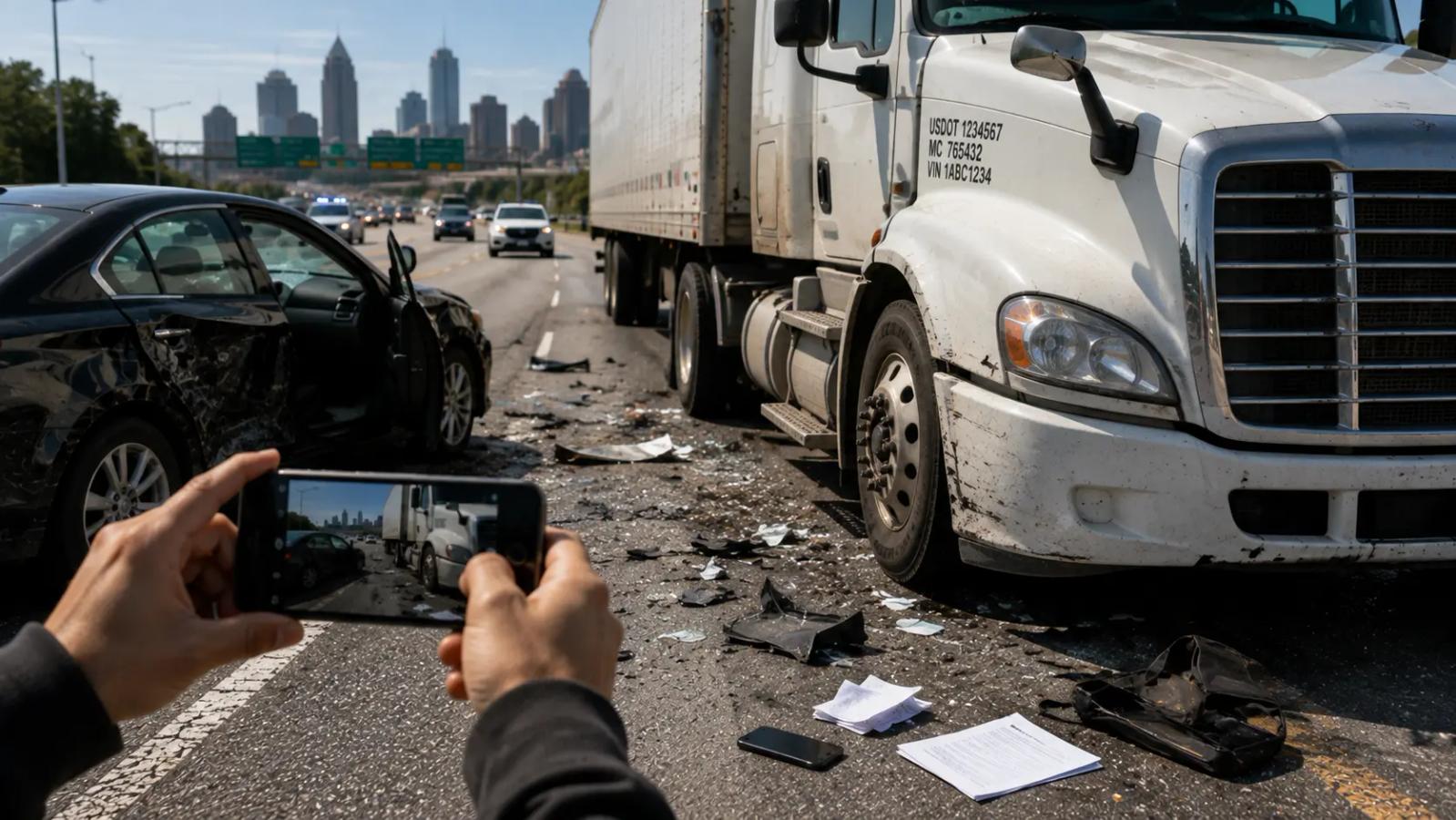
A name and phone number from anyone who saw the crash is usually enough, so gather evidence from witnesses while they are still on scene rather than waiting to see if you need it. Witnesses move on with their day fast, and a statement collected a week later is far less useful than one collected in the first ten minutes.
What Not to Say to Insurance Adjusters
An insurance adjuster from the trucking company's insurer may call you within a day or two, sometimes sooner. They will sound helpful. Their job is to close your claim for as little as possible, and a recorded statement given before you understand your injuries is one of their most effective tools.
You are not required to give that statement, and you are not required to accept the first number they offer. Notify your insurance company of the accident as you normally would, but keep any conversation with the other driver's insurance representative short: confirm the basic facts, and decline anything recorded until you have spoken with someone who handles these cases for a living. If you want the fuller playbook for handling insurance companies after an accident, it applies just as much here.
Why Evidence Disappears Fast After a Truck Accident
This is not a hypothetical risk. Public crash data for Georgia shows 81,768 truck and bus crashes between 2015 and 2025, including 2,661 fatalities and 42,802 injuries, close to 4 percent of every reported truck and bus crash in the country and enough to rank Georgia seventh among all states, roughly double the average state's volume. Freight traffic through Atlanta and along I-75, I-85, and I-285 creates a level of exposure most other states don't see, which is exactly why large trucking companies do not wait to see if you hire an attorney before they start protecting themselves. Many carriers dispatch a rapid response team to serious crash scenes within hours, sometimes before the wreckage is even cleared.
Waiting a few days to see how you feel is the single most common way people lose a case they should have won. The injury was real. The evidence that would have proven it was gone by the time anyone went looking for it.
Their goal is to preserve evidence that helps the trucking company and let the rest disappear. A truck's black box data from the vehicle's electronic control module can record speed, braking, and driver actions in the moments before impact, but many systems overwrite this data on a rolling cycle. Dashcam footage gets deleted on a similar schedule. Hours-of-service logs that would reveal a fatigued truck driver can be corrected or reissued if nobody has asked for the originals yet.
Maintenance records and driver qualification files tell a similar story. Federal regulation requires carriers to keep inspection logs, repair histories, and proof that a driver was properly licensed and screened before ever getting behind the wheel. Worn brakes that should have been flagged at the last inspection, or a driver hired without the required background check, can shift a case from simple negligence into something closer to corporate carelessness. None of that surfaces on its own. Someone has to ask for it before it gets buried in routine paperwork or lost to a retention schedule.
That's why these cases play out differently from ordinary car accident claims. A personal injury lawyer who handles commercial vehicle collisions knows to send a spoliation letter immediately, which legally requires the trucking company to preserve this evidence rather than let it vanish on schedule. Waiting even a few weeks to contact an attorney can mean the evidence that proves your case no longer exists, and no amount of skilled negotiation afterward brings it back.
How Long Do You Have to File a Truck Accident Claim in Georgia?
You have two years from the date of the accident, under Georgia law, to file a personal injury lawsuit for injuries caused by a commercial truck crash. That sounds like plenty of time, and in one sense it is. In every other sense, it is not, because the strongest evidence in a truck accident claim degrades fastest in the weeks immediately after the crash, not in the months before the deadline.
The two-year window is a legal deadline. It is not a strategy.


There is a second reason speed matters in Georgia. Under O.C.G.A. § 51-12-33, the state's comparative negligence rule, your compensation can be reduced by whatever percentage of fault gets assigned to you, and you lose the right to recover anything if you are found 50 percent or more at fault. Early, thorough evidence is what keeps that percentage low. The longer the trucking company has to build its version of events, the more of that percentage lands on you.
When to Contact a Truck Accident Lawyer
You do not need to have every detail sorted out before you contact a truck accident lawyer. None of this costs you anything upfront: attorneys who handle these cases typically work on contingency, so you pay nothing unless the case results in a settlement or verdict. A legal team that handles these cases daily matches the pace already described above: securing the evidence, identifying every party who may share legal liability, and handling communication with the insurance companies so you are not negotiating your own injury claim while you are still recovering.
Truck accidents often involve more than one liable party, and figuring out which party may carry the greater share of fault is rarely obvious from the scene alone. The driver, the trucking company, a cargo loading company, or even a truck manufacturer can each carry a share of responsibility depending on what caused the crash. Sorting that out is not something you should have to figure out alone while you are dealing with medical bills, lost income, and a truck that may not be drivable.
If you were hurt in a truck accident in Georgia, the choices you make in the first few days shape what your case looks like months from now. A truck accident attorney at Gillani Law offers a free consultation to review what happened, explain what your claim may be worth, and outline next steps with no pressure to decide anything on the call. You focus on getting better. The call costs you nothing and tells you exactly where you stand.